


On the evening of 13th August, Pillar VC and CompMotifs1 brought 80 scientists, AI engineers, founders and funders together at Pillar’s new King’s Cross office for an experiment in structured debate to surface where AI is and isn’t working in science.
The evening also gave us a chance to introduce the Encode: AI for Science Challengescape: a living directory of open scientific problems where AI expertise is needed to advance the field and build solutions. These scientific challenges are submitted directly by domain experts across the UK who hold access to data and critical infrastructure such as wet-labs and testing sites. The problem that the Challengescape is trying to address — helping AI researchers and scientists apply their skills to interesting scientific problems — happened to be one of the clearest themes of the night.
How the evening worked
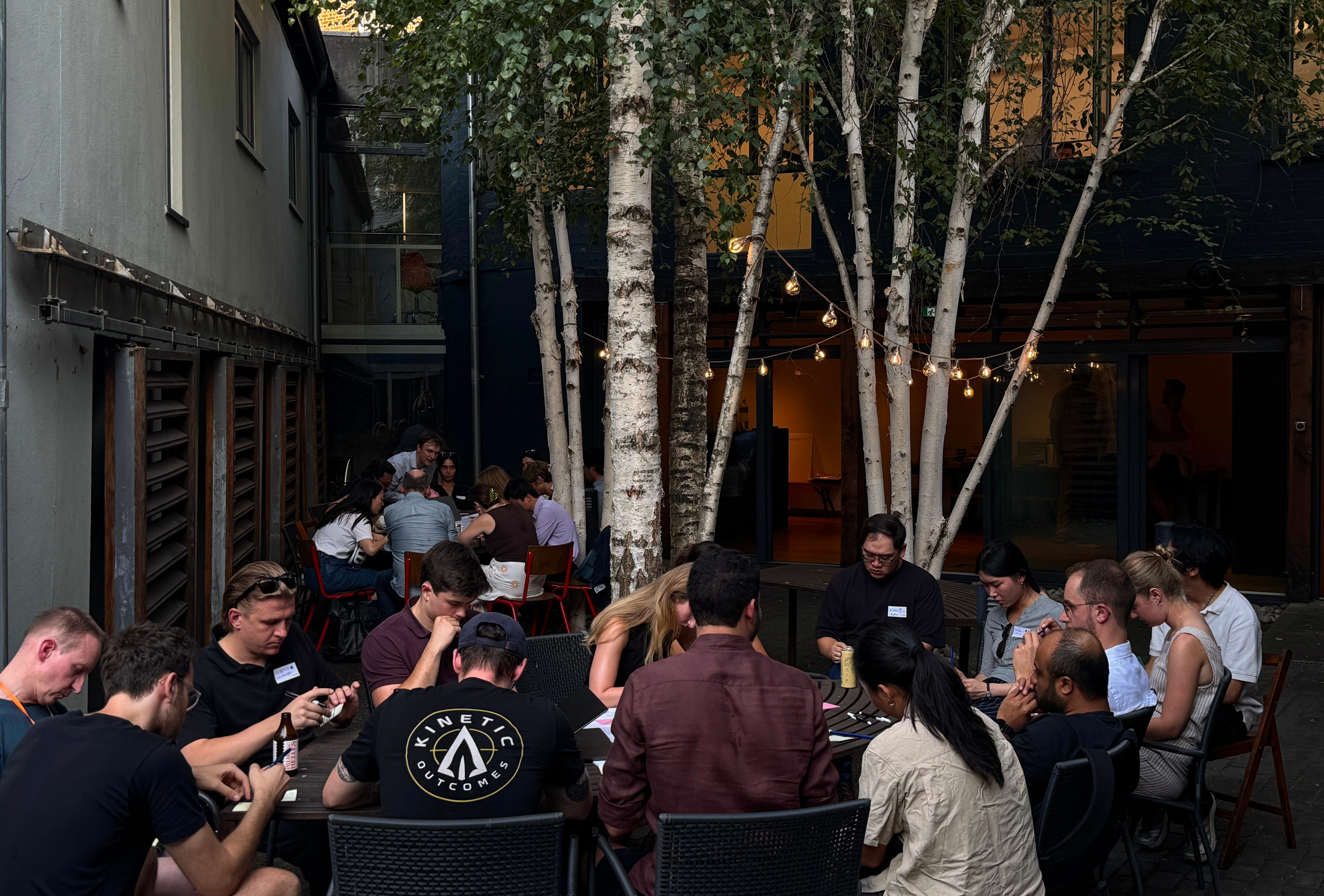
We split the discussion across three levels, with two tables running in parallel at each:
Lab-level: what breaks day to day when experimental scientists and AI engineers try to work together?
Community-level: what causes friction between labs — finding collaborators, sharing credit or attracting talent?
Institutional-level: what are the bottlenecks above individual labs — infrastructure, incentives or the scientific record?
Each table received three prompts with 40 minutes to discuss them. We used design-thinking approaches to spark productive conversations: counterfactual questions, jobs-to-be-done framing, and solution-oriented language (“how might we…”?). We retired topics that dominated the pre-event survey responses, most notably data quality and standardisation, and trust and model explainability. People could still raise them, but only if they could say something more specific about what was actually going wrong.
This post summarises the survey responses, brainstorming sticky notes, and table transcripts. Across all of these a broad pattern emerged: AI capability is advancing faster than many of the scientific structures around it.
In the lab: where should AI actually intervene?
At the lab-level tables, we started with the practical relationship between experimental scientists and AI engineers. Some of the most useful examples came from asking a simple question: can you think of a time when a model’s output actually changed what you did at the bench?
One group described how AI came up with a different approach to rank antibody candidates than the lab’s standard approach. It was interesting to see that AI was being used to provide an orthogonal way of looking at the same molecules, instead of just accelerating the standard approach of the scientist. Another example came from biomedical engineering, where researchers changed their planned experiments after a model helped surface a decades-old theoretical result from information theory that happened to map onto their problem.
Both examples suggest a useful way of thinking about the value of AI in the lab. The biggest gains may not always come from getting a model to perform an existing scientific task better. Sometimes they come from giving the researcher a new way to see the problem.
Both examples involved AI finding a different way to look at a problem within a particular scientific domain. The harder question is whether that ability can extend across domains that represent the world in fundamentally different ways — equations in physics, structures in chemistry, sequences in biology. Can a single AI system reason across those representations, or will science require specialised models that can translate between them? Here, the tables disagreed.
One view was that large multimodal models could eventually provide a sufficiently general substrate across domains, but today’s models simply aren’t capable enough yet. The counterargument was that some scientific domains are too high-dimensional, continuous or specialised to fit comfortably into a single model. Some participants imagined specialist models for different scientific domains, coordinated through something closer to a translation layer.
The different languages of scientific domains are of course a challenge for humans too. A consensus on the night was that collaboration between scientists and AI domain experts can benefit from a clearer understanding of each other’s workflows and requirements. Participants noted that people from computer science backgrounds may have had less exposure to some aspects of wet-lab experimental design and hypothesis building, calling for more crosdisciplinary exposure. Similarly, wet-lab researchers may not always have training in structuring and capturing data with downstream AI use in mind. Participants discussed this as a potential source of friction when trying to make existing experimental data more useful for AI training and inference.
Taken together, these discussions pointed to an opportunity: more knowledge sharing and interdisciplinary training could help teams work together more effectively, while encouraging data practices that support later AI use. That could help address a practical bottleneck in collaboration and make it easier to capture more value from experimental data.
Between labs: finding the person you don’t yet know you need
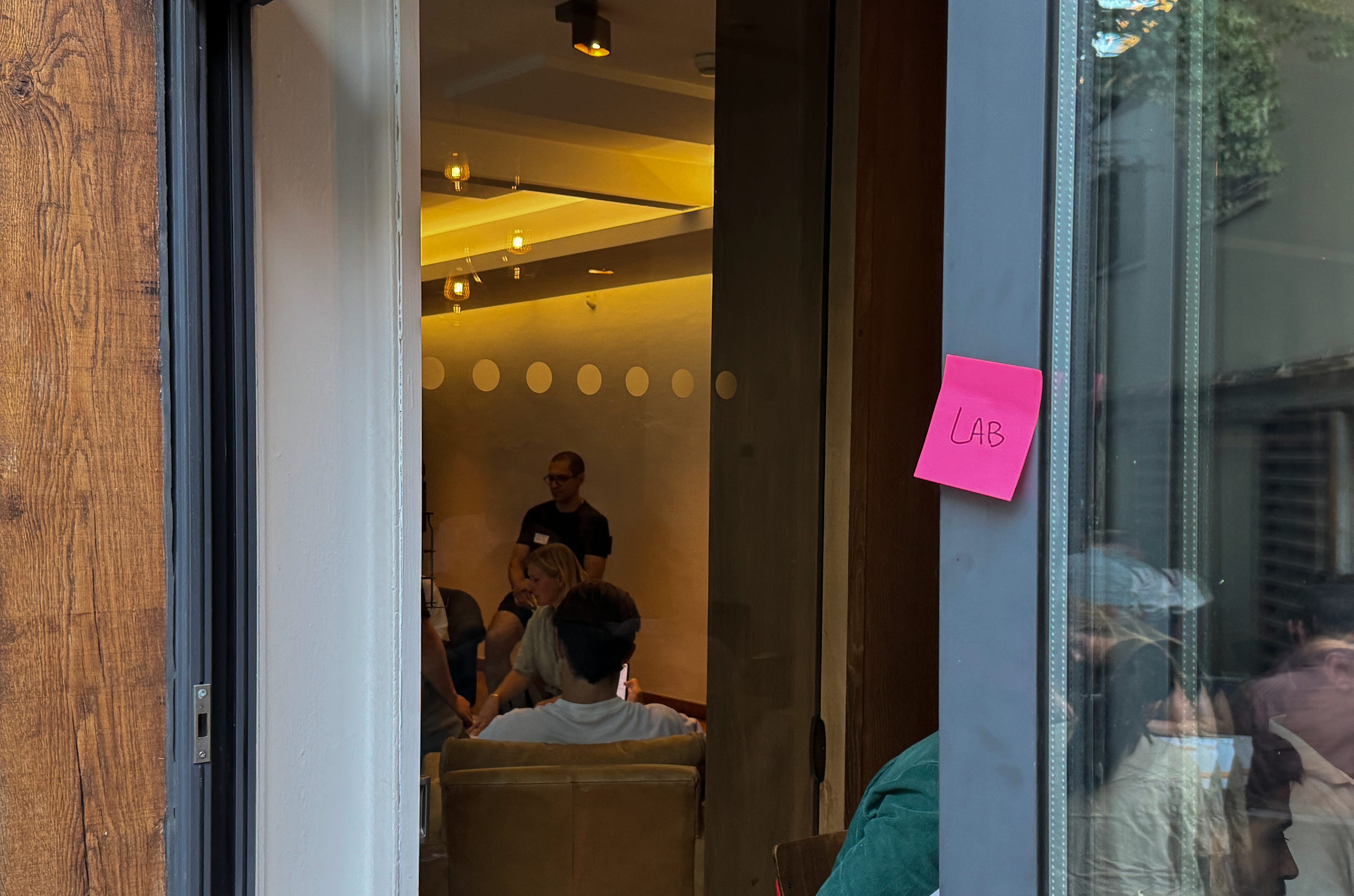
At the community level, the conversation shifted focus, away from people who already collaborate and towards people who never find each other in the first place. We asked how researchers might find the right collaborators outside their discipline before they hit a roadblock.
Both tables independently arrived at versions of the same established problem: conferences and professional networks are good at helping you find somebody once you broadly know who you are looking for. They are much worse at the earlier stage, when you don’t yet know which neighbouring field might contain the technique or person your problem needs.
Several concrete interventions emerged. One was a funder-mandated interdisciplinary questionnaire at the beginning of a project, making researchers consider relevant expertise outside their immediate field before work starts. Another was facilitating knowledge sharing by deliberately bringing more people from adjacent fields into conferences, rather than allowing the same narrow networks to reproduce themselves year after year.
When we discussed attracting AI talent into science, a few additional challenges appeared. Salary matters, particularly when the alternative is working in finance or technology. But participants also repeatedly pointed to other factors: unclear routes to technical leadership for computational researchers inside scientific organisations; questions around credit and IP; bureaucracy; and the difficulty of discovering and understanding interesting scientific problems in the first place. Many AI experts mentioned that they had significant capacity to hack at problems and were looking for meaningful scientific research to work on, but discovering and practically engaging with such projects was what held them back.
Discovering meaningful opportunities to collaborate and the right collaborators is a gap that the Challengescape was designed to help alleviate. Rather than starting with profiles of people who might collaborate, the Challengescape starts with the problems themselves: open scientific challenges submitted by the labs working on them. The aim is to provide a map that allows someone with relevant AI expertise to discover and engage with a problem worth working on — including problems in fields they might never have thought to search.
Above the lab: who can change the system?
At the institutional level, the conversations became broader. One table divided infrastructure gaps into three categories: gaps in the data itself, gaps in the infrastructure for moving and evaluating it, and gaps in people’s ability to work across disciplines. Their conclusion was that these aren’t entirely separate problems and that many are shaped by the incentives surrounding them.
The scientific record was a particularly clear example. Negative results and failed experiments rarely make it into the published literature. Experimental details can be incomplete. Data remains trapped in legacy systems or in formats that were never designed to be easily machine-readable. This is a problem for scientists already, but it becomes particularly consequential when AI systems are expected to learn from that record.
One proposal was to rethink the paper itself as the fundamental unit of scientific knowledge. Instead of recording science primarily as finished narratives, participants discussed something closer to a discourse graph: explicit claims, assumptions and results connected in a machine-readable structure. Whether that particular model is right is less important than the underlying question: If AI changes how scientific knowledge can be searched, combined and interrogated, should the way we record science change with it?
The institutional tables also confronted incentives more directly. We asked how scientific institutions might reward interdisciplinary and high-risk work, and who actually has the power to change those incentives. The discussion ranged widely. Some argued for a radical restructuring of universities and research organisations; others pointed out that markets and short political cycles are hardly obvious replacements for institutions capable of supporting long-horizon research, such as universities.
Although no consensus was reached, there were more specific ideas around on which people could agree. One was moving some peer review earlier in the scientific process: reviewing and registering experimental designs before results are known, then publishing outcomes regardless of whether they are positive. That would make negative results part of the scientific record while reducing some of the incentives to tell a clean story after the fact.
The same problem at three different scales
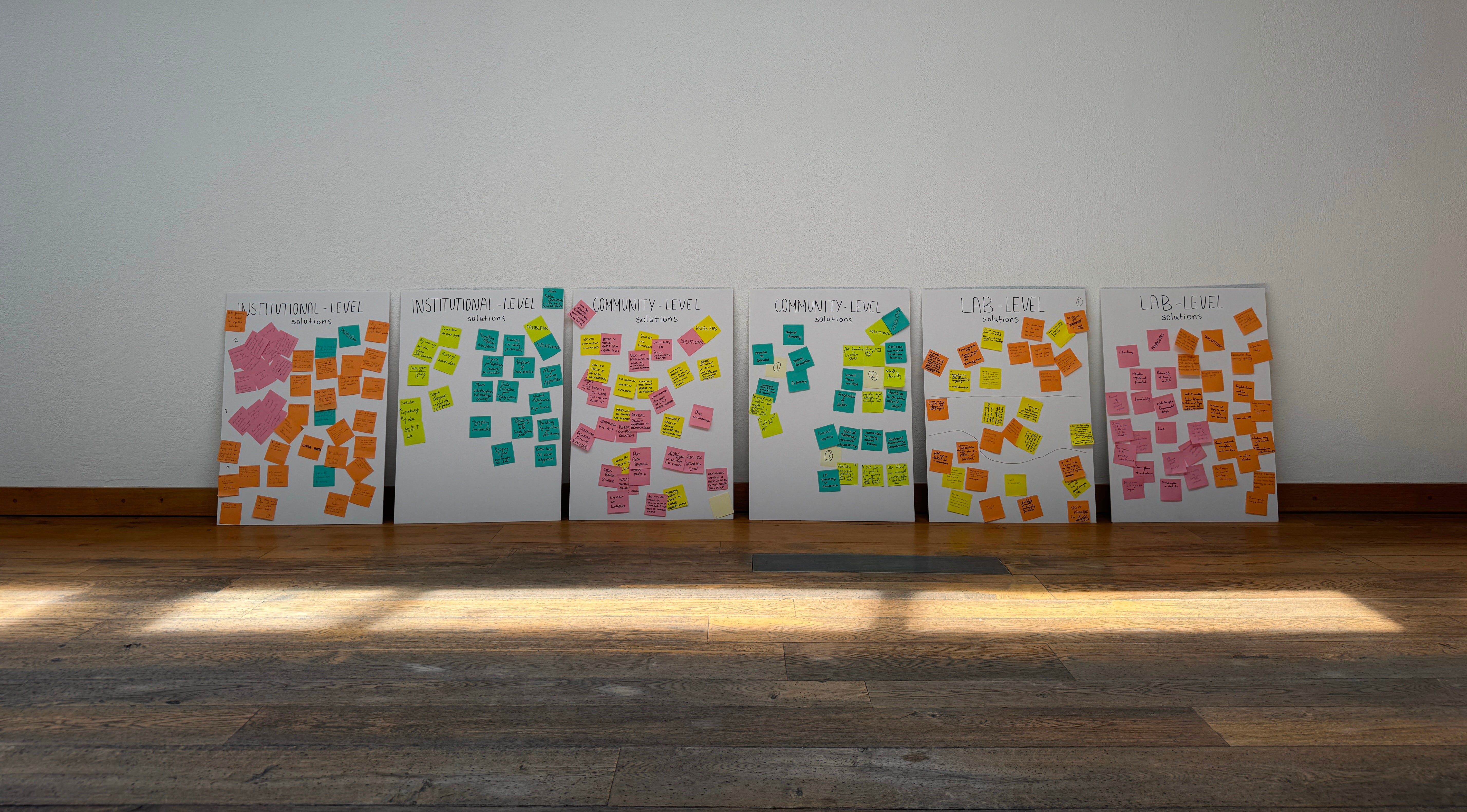
Looking back across the conversations, the three levels were less separate than they initially appeared.
At the lab level, AI can generate predictions or suggest experiments faster than researchers can necessarily validate them.
At the community level, expertise exists but the people who need each other often don’t discover one another until too late in a project.
At the institutional level, the scientific record and the incentives around producing it have not evolved at the same speed as the tools now being applied to it.
There was also a familiar quality to some of these conclusions. Earlier this year, CompMotifs published an opinion piece in Patterns drawing on a series of workshops and hackathons about recurring barriers to AI in science. It highlighted several of the same problems that resurfaced here: translating science into forms computers can use, the loss of negative results, and incentives that make interdisciplinary, high-risk work harder than it should be. The recurrence of these problems at this more recent event with a much larger and more varied group suggests that these are not simply the concerns of one community or one evening, but persistent features of the landscape worth trying to change.
Overall the evening suggested that model capability alone is an incomplete measure of progress in AI for science. A prediction that cannot be validated, a tool that cannot fit into a lab’s workflow, an expert who cannot find the right problem, or a result that disappears because the experiment “failed” all limit what greater model capability can accomplish.
The challenge, then, is not simply to make AI more capable. It is to make the structures around science capable of using what AI can already do.
What happens next
Some problems from the evening are defined enough to begin thinking of solutions:
To facilitate more effective collaborations between AI experts and scientists, both must better understand each other’s work.
To catch missing expertise before it becomes a roadblock, funders should require researchers to identify who outside their own field might be relevant to a project before the work begins.
To help AI researchers find scientific problems worth working on, platforms such as the Challengescape accessibly present scientific problems.
To facilitate greater transparency of the scientific process, a platform to review experiments before they are run could be built, with outcomes published regardless of whether they succeed or fail.
Others should remain open questions. How much agency should AI have in choosing research directions? What should a research organisation built around scientific problems rather than traditional disciplines look like? Do we need a new computational representation of scientific knowledge, or better coordination between specialised ones?
We don’t think an evening of discussion alone can resolve these questions, but it can make the problems more legible. On top of legibility, collective focus should be on making it easier for people who are motivated to work on them to find one another.
What we came away with after the evening was less a list of answers than a clearer picture of where to look: not only at the models, but at the people, labs, communities and institutions that AI needs to work with to facilitate a new age of scientific discovery.
Authors: Wojtek Treyde, Aleksy Kwiatkowski, Rory Byrne, Emily Kostina, Murray Cox, Callum Tilbury, Leah Morris.
This article was a collaborative piece of work with CompMotifs and is not Pillar VC’s own publication.
Interesting that data quality was retired because it dominated the survey. I suspect it dominated because it is one word covering several problems. Registering designs before results are known fixes one of them: completeness, the failures that never reach the record. Others need different fixes, like whether a measurement matches the biology, or whether anyone outside can compare one group's data with another's. A prediction nobody can validate is the same gap from the model side. Which of these would the group pilot first?